
Quantitative Economics
Curriculum: "Quantitative Economics" [QE]
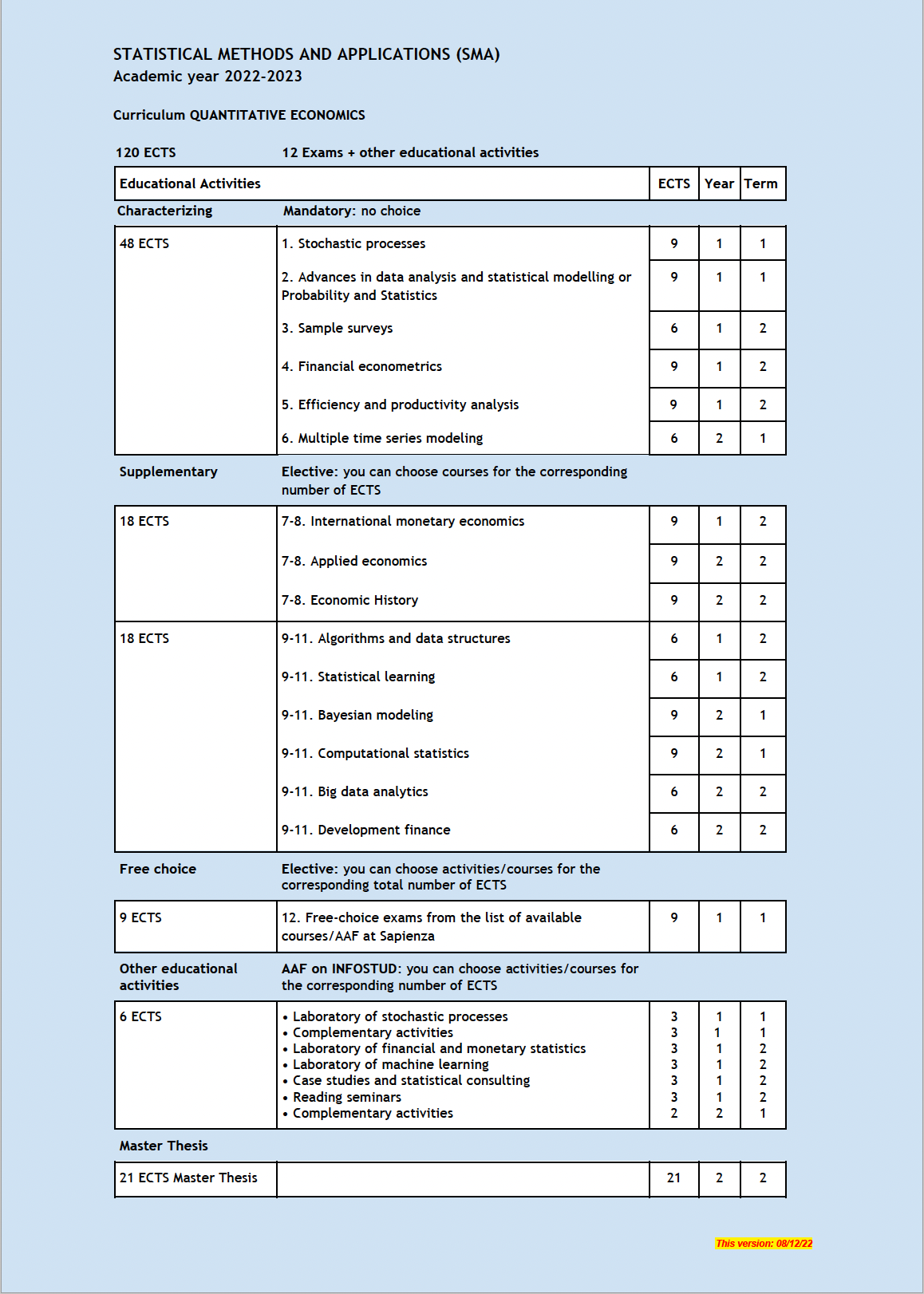
The "Quantitative Economics" (QE) curriculum is designed to train graduates with a solid knowledge of statistics and probability, economics and econometrics to analyze data for solving real economic problems. In synthesis, economic models are viewed as population models, in a world characterized by uncertainty, from which data are drawn, and QE considers all the inherent methodological aspects. Then, to summarize, it covers advanced courses of stochastic processes, bayesian modeling, optimization, statistical learning as well as multiple time series, panel data and applied economics and econometrics for understanding international, development and macro-finance problems.
SMA/QE graduates will then be able to define economic scenarios and use them as a basis for quantitative studies, which will typically include causal and counterfactual studies, as well as forecasting. More specifically, at the end of this course students should possess the necessary methodological skills (in terms of probability, statistics, economics and econometrics) to tackle dynamic and cross-section empirical economic problems as well as to quantitatively assess the effectiveness of policy decisions, using time series and panel data. As a result, they will be equipped with the mandatory computer literacy for computer programming. Also, the QE path allows for a double degree with ENSAI (Rennes), Quantitative Economics - Master Mathématiques Appliquées, Statistique, parcours Science des données pour la decision publique (Statistical Studies path).
Students who pass this demanding course will be ready both to pursue academic research in quantitative economics and to access labor markets, oriented towards international institutions (very often in study offices) and the private sector, where the use of statistical tools for examining economic data is now mandatory.